
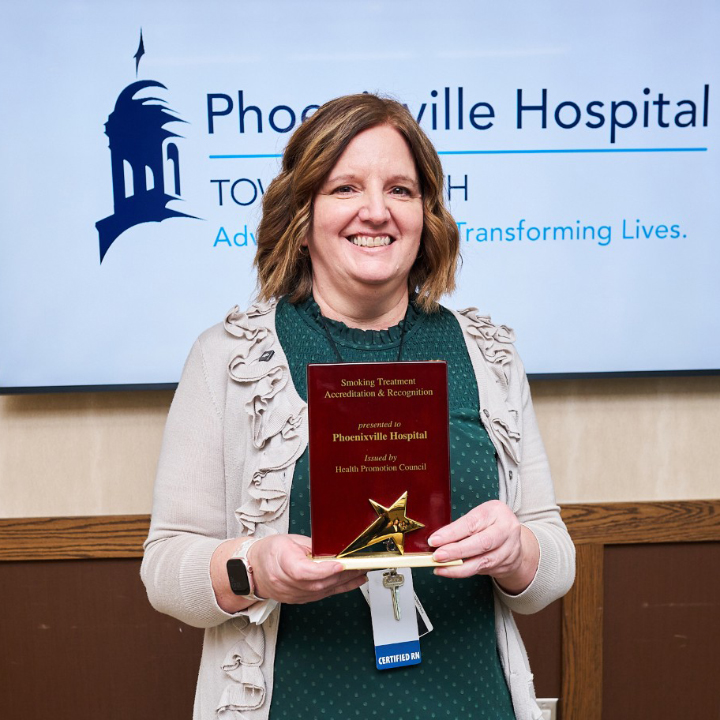
Michelle Evans, BSN, RN, CTTS, Community Health Education and Outreach, has spent 18 years helping patients through one of the hardest decisions of their lives: quitting smoking, even when it feels nearly impossible.
“Michelle has been a blessing in my life,” a program participant shared. “She guides me through each step of my journey and provides realistic advice and goals. Each patient has different triggers or stressors, and Michelle has helped me create a program that works best for my life. I am truly grateful for her support.”
Nearly 50 percent of Evans’ tobacco cessation program participants have remained nicotine-free. That success helped Phoenixville Hospital earn its first Smoking Treatment Accreditation and Recognition (STAR) designation from the Health Promotion Council, a subsidiary of Public Health Management Corporation.
The recognition underscores the hospital’s commitment to integrating evidence-based tobacco treatment into patient care, improving outcomes, and reducing readmissions.
A Leader Behind the Program
Evans, a recent DAISY Award recipient, leads support groups, partners with schools, and provides education designed to prevent smoking and support long-term recovery. Her work focuses on meeting patients where they are, whether in the hospital or in the community.
“We’ve inspired students to not try tobacco or vaping throughout our programs, and we’ve seen patients who never thought they could quit finally walk out smoke-free,” she said.
Expanding Access to Quit-Smoking Support
Under Evans’ leadership, Phoenixville Hospital developed a program that connects patients to tobacco treatment resources at multiple points of care. The goal is to make quitting more accessible and sustainable.
Smoking remains the leading cause of preventable death in Pennsylvania, making programs like this critical to improving community health.
Joining Leading Health Systems
With this recognition, Phoenixville Hospital joins institutions such as Jefferson Health, Children's Hospital of Philadelphia, University of Pennsylvania Health System, and Fox Chase Cancer Center that have earned STAR accreditation.
“Michelle’s leadership and commitment have helped expand access to care and support for patients who want to quit,” said Rich McLaughlin, MD, president and CEO of Phoenixville Hospital and Pottstown Hospital. “She’s helping patients and community members live healthier lives."
The initiative is supported by Tower Health as part of a broader focus on prevention and community health.
"Initiatives like this show the power of community-centered care and meeting people where they are,” said Michael Stern, president and CEO of Tower Health. “Helping individuals quit tobacco has a lasting impact on families and communities.”
How to Get Help Quitting Smoking
Phoenixville Hospital and Tower Health offer counseling and support for individuals who want to quit smoking. Contact Michelle Evans at 610-983-1021 or michellep.evans@towerhealth.org to learn more about our community-based resources, including the Tobacco Dependence Treatment Program, support groups, in-person classes, and virtual classes.