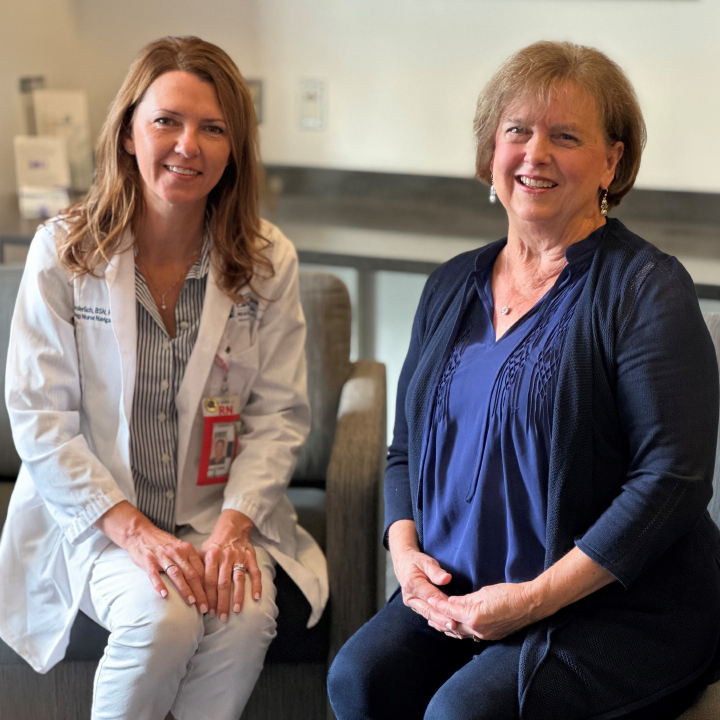
Sunday was diagnosed in December 2025 after a routine screening mammogram. Her mother died from breast cancer at age 41, when Sunday was a senior in high school. “I had always wondered if one day it would happen to me,” Sunday said of her own diagnosis. Because of her family history, Sunday had decided that if she were ever diagnosed with breast cancer, she would choose a mastectomy. Her treatment included 12 weeks of chemotherapy, and she will take a hormone therapy pill for five years.
Before her diagnosis, Sunday was unfamiliar with scalp cooling. When Sherri Wunderlich, oncology nurse navigator, introduced it as an option, Sunday took only a few days to decide it was right for her. Scalp cooling uses a specialized cooling cap during chemotherapy to help reduce hair loss. Results vary, and the technology does not guarantee that patients will keep their hair, but it can help some patients preserve more of it during treatment. For Sunday, the availability of the technology at no cost was an important consideration.
“I might not have done it if I had to pay for it out of pocket,” she said. “I don’t know what I would have done.”
The Friends of Reading Hospital purchased the scalp cooling equipment, making the treatment available at no cost to eligible patients at McGlinn Cancer Institute. The investment helps remove a potential financial barrier for patients who want to explore ways to manage chemotherapy-related hair loss.
Wunderlich said patient education is an important part of the process. The care team discusses what patients can expect before they decide whether to include scalp cooling in their treatment plan. Not every patient or chemotherapy regimen is equally suited to the technology, making those conversations an important part of the decision. According to Wunderlich, Sunday was an ideal candidate because her chemotherapy regimen has been shown to work well with scalp cooling.
“We talk with each patient in advance about what they can expect if they choose to include scalp cooling as part of their treatment,” Wunderlich said.
Sunday is very pleased with her results, experiencing only minimal hair shedding. As she considered where to receive treatment, Sunday spoke with two people she knew who had been treated at McGlinn Cancer Institute. Both shared positive experiences, and she ultimately chose McGlinn because it was closer to home and recommended the same treatment protocol as another hospital she had considered.
“The team handled me and everyone in the infusion center with dignity and respect,” Sunday said. “They are true professionals in a difficult atmosphere, and they made the whole experience more comfortable.”
Sunday recognizes that scalp cooling is a personal decision. She encourages other patients to understand the process, including the time commitment, before deciding whether it is right for them.
“Not every journey is the same,” she said. “You need to find a medical team you have total confidence in and that can support you through the process. At McGlinn Cancer Institute, you will be well taken care of.”
Scalp cooling is available to eligible patients undergoing chemotherapy at McGlinn Cancer Institute, regardless of their type of cancer. Patients interested in the technology can speak with their care team to learn whether it may be appropriate for their treatment.