
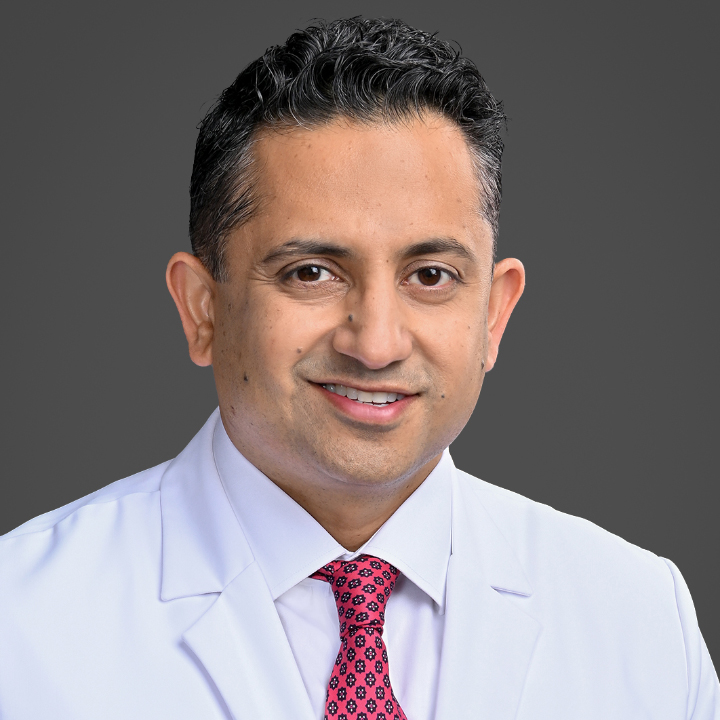
When Archit A Naik, MD, talks about innovation in breast cancer surgery, he doesn’t start with technology. He starts with people.
“Patients come to you at one of the most vulnerable times in their lives,” said Naik, a breast surgical oncologist with Tower Health. “My responsibility is to make sure I’ve done the work, so they have access to the safest, most effective options available.”
That commitment recently led Naik to perform an endoscopic nipple-sparing mastectomy at Tower Health Medical Group Breast Health Center - Phoenixville. It’s a highly specialized procedure that until now was largely unavailable to patients in the region.
According to a medical device manufacturer involved in the surgery, Naik is the first surgeon in Pennsylvania to perform the procedure. He and his colleague, Olivia W Galloway, MD, are also two of the few surgeons on the east coast trained in the technique by physicians from Italy and Spain, where the approach was perfected.
“It’s significant,” Naik said. “Before this, a patient would have had to travel to Italy or Spain to get it done. My goal is to keep pushing myself so I can provide the best care for my patients right here, close to home.”
A Minimally Invasive Approach with Major Impact
At its core, an endoscopic nipple-sparing mastectomy is similar in concept to other minimally invasive surgeries many patients are familiar with, such as laparoscopic gallbladder surgery or arthroscopic knee repair.
Instead of a large incision across the breast, the surgeon operates through a small incision of about 3 to 3.5 centimeters. Importantly for aesthetic results, the incision can be made in a less-visible location. Long, specialized instruments and an inserted camera allow the surgeon to see the entire surgical area and work with precision.
“In the endoscopic procedure, the underside of the nipple and areola can be better visualized when compared to the traditional open procedure. The camera also magnifies the anatomical structures. The combination of magnification and better visualization enables a more precise surgery that can result in better outcomes."
Just as important, studies show the procedure has the same cancer-fighting effectiveness as a traditional mastectomy. “That’s always the number one priority,” Naik said. “The cosmetic result matters, but oncologic safety comes first.”
Why Preserving the Nipple Matters
For many patients, nipple preservation makes a meaningful difference, both physically and emotionally.
“Physically, it helps maintain the natural contour of the breast and allows for a more seamless reconstruction,” Naik said. “Emotionally, patients feel more like themselves after surgery. There is generally a less sense of loss when we can preserve the nipple and areola.”
He added that for many women, the nipple is closely tied to body image and identity. “When patients feel better emotionally, they tend to recover better physically, too,” Naik said.
A Patient’s Journey, Without Leaving the Community
Naik’s patient, who underwent the surgery, illustrates why access to advanced care close to home matters so deeply.
He first met her three years ago. She was in her late 30s, with young children, and had undergone a lumpectomy and radiation for breast cancer. Although her treatment was successful, her fear lingered.
“She lived with that worry for years,” Naik said. “Eventually, she decided she wanted a mastectomy for peace of mind.”
While a mastectomy (which removes about 95 to 97% of breast tissue) does not reduce cancer risk to zero, it significantly lowers the risk. Because of her age, health, goals, and breast size, she was an ideal candidate for the endoscopic nipple-sparing approach.
After surgery in late 2025, the results were striking.
“When she stood in front of the mirror, she couldn’t see a scar,” Naik said. “She could feel that things were different, of course, but visually, it was remarkable. Her husband told me he couldn’t even tell she had surgery.”
Today, she’s back to her everyday life, spending time with her family and looking forward to going to the beach in a swimsuit. She’s also grateful she was able to receive this level of care without traveling far from home.
“That support system is so important when you’re going through cancer treatment,” Naik said. “Being close to family makes a real difference.”
A Career Built on Innovation and Responsibility
Naik, who grew up in Lansdale and completed his medical education and general surgery residency at Drexel University College of Medicine, joined Tower Health in July 2025 from Jefferson Einstein Montgomery Hospital.
He provides comprehensive care for breast disease, from diagnosis through surgery, and coordination with radiation and medical oncology, using the latest evidence-based approaches.
Since joining Tower, he has already introduced new technologies, including advanced breast cancer localization devices that replace older, wire-based methods. The newer approach allows surgeons to remove cancer more precisely, improve cosmetic outcomes, and reduce stress for patients on surgery day.
The new device allows surgeons to make an incision where it is aesthetically and oncologically optimal.
“It’s becoming the standard other breast surgeons want,” Naik said, adding that he’s been teaching the use of localization device to other surgeons around the country.
Naik has also been at the forefront of earlier innovations. His patient was the first to undergo a robotic mastectomy in the USA. Naik collaborated with his colleague Stephen A. Chagares, MD, FACS, who actually performed the procedure.
“We push ourselves to try new things,” he said. “Some don’t work, and that’s part of learning, but it’s our job to do this responsibly, with data, oversight, and full transparency for patients.”
Looking Ahead
Naik sees the future of breast cancer surgery becoming increasingly personalized, driven by better data and emerging artificial intelligence tools that help tailor treatment.
“More precise care, more individualized decisions, and better predictions about who needs what treatment; that’s where we’re heading,” he said.
For patients who are newly diagnosed and afraid, his message is simple:
“Treatments are so much better now. Most of the time, breast cancer is very treatable,” he said. “You’re not alone. We will walk with you through the entire journey, providing an empathetic shoulder to lean on while also pushing ourselves to ensure that you have access to the latest advances.”
At Tower Health, that journey increasingly includes world-class care, delivered close to home. Learn more about how we’re advancing breast health care in our region.